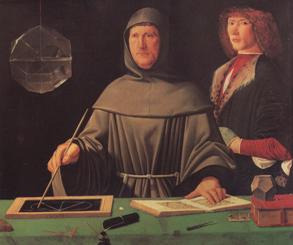
Luca Pacioli
 |
Enterprise Resource Planning (ERP) |
|
The contribution of Luca Pacioli (1494)
|
The historian agree that double sided booking has been initiated by Franciscan father Luca Pacioli (1445-1517) and his publication from the year 1494. In his act „Summa“ the mathematician has written a summary of the mathematical methods of his times. In the famous Tractatus XI with the title „Particularis de computis et scripturis“ Pacioli describes the rules of bookkeeping as they were applied at that time by the northern Italian trading houses.
Luca Pacioli: Summa de arithmetica, geometria, proportioni
et
Through the use of the booking line as an intermediate element the accountant attempted to assure that every change on the principal side had its counterpart on the believer side. If any deviations were found, they had to be reported as profit or loss, get attributed to the business event and moved to a summary account “profits and losses”. At the moment of closing, this account was cleared with the owner’s equity. Such deviations arose typically from the inventory, when the sales price was higher than the purchase price, and the difference immediately to be attributed to the profit. Therefore, the goal of the bookkeeping was not just to keep principals and believers in a balanced position, but rather to calculate the profit for each business case and attribute it immediately to the profit and loss account or the owner’s equity account respectively. It is interesting to note that Pacioli did not present any propositions for the summarisation of the profits or losses per client, what would have given the base of a simple controlling. It is possible that this kind of view on the client relation at that time was not considered desirable yet. According to Pacioli the accounting was „in balance“, if the sum of the principal as well as the believer side separately added would give the same (positive) amount. Were the amounts of the believer side considered as negative values, then the accounting was “in balance”, if the sum of all principal and believer values resulted in a total of zero. Mathematically, the double sided accounting of the Middle Ages can be considered as a list of booking values, whose total resulted in an amount of zero. Are the positive amounts attributed to the collective name “assets” and the negative amounts to the collective name “liabilities” we get a balance with a total of zero. In Pacioli’s work already is apparent, how profits and losses emerge from not furthermore explainable changes in value. As Paul Weilenmann (Grundlagen des betriebswirtschaftlichen Rechnungswesens, Sauerländer/SKV 1988, page 21) brings it to the point, it is seems reasonable to separate not furthermore explainable asset gains and losses from the balance and attribute them as expenses and revenues to a separate income statement. This way we get to the typical partitioning of today with assets, liabilities, expenses and earnings. As soon as we allow bookings between balance and income statement emerges a difference between assets and liabilities and the inverted difference between expenses and earnings. This difference we denominate as profit or loss respectively. It is the sum of the not furthermore explain-nable difference between expenses and earnings (see Paul Weilenmann,ibidem).
Balance and income statement with explainable and
The accounting system is defined as a list of at least an account and an amount, with a total of zero for all amounts of the list, whereas the accounts are attributed to the four types (assets, liabilities, expenses and earnings), and the profit is calculated in the balance as the sum of assets + liabilities, and the negative profit amount in the income statement as the sum of expenses + earnings. Bookings can bee added in any way, under the sole condition that the sum of the new bookings would also result in a total of zero. |
|
|||||||||||||||||||||||||||||||||||||||||||||||||