Luca Pacioli
 |
Enterprise Resource Planning (ERP) |
|
Process oriented accounting
|
If you compare registered batches of an accounting system, you will soon recognize that the booking patterns are frequently repeated. Receivables, payables, payments, payroll, bank interests and expenses, depreciation, tax: all these processes follow a particular booking pattern. For the accountant as well as the auditor it seems rewarding to analyse and verify not every singular batch, but batches grouped into processes. For the assignment of bookings to batches and processes single sided as well as double sided bookings can be used. It is only necessary to make sure that the sum of all entered bookings result in a total of zero. With double sided bookings this is always the case, since every booking line will add the positive amount for the debit and the same but negative amount for the cr edit account. With single sided bookings, the user can only commit the batch if the zero total condition is fulfilled. With today's information technology resources it is not really difficult to check batches for a total of zero over all bookings. Incorrect entries can be easily identified and modified. The batch can also be used for the preliminary register of still incomplete data and be committed at a later moment of time to the accounting system.
Example of a process structure in a Typical processes to group batches are e.g. purchase and sales, payments, interest calculations, capital increase, but also processes not relied to a cash movement like depreciation, establishment of reserves, etc. For each process a small balance and income statement can be established. Since the process follows a homogenous pattern, the report will only include very few accounts. For this reason incorrect bookings are easily identified. With drag and drop accounts can be assiciated with processes. Through this procedure the user can generate process related accounting patterns. Later, when entering bookings, the accounting pattern is used for a preselection of accounts, presented in a combobox. The preselection will make data entry much more efficient and help considerably to reduce accounting errors.
Master process "booking" with processes "credit", "debit", For each process, a profit or loss can be calculated as well, and the addition of the total company profit be tracked over all processes involved. In this context it may be valuable to differ between two process classes grouping cash relevant batches (e.g. interest, expenses) on one side and batches with calculatory bookings (e.g. depreciation) on the other. The total over all bookings per process must be zero again, and the balance profit equal the negative value of the income statement profit.
Overall profit as a the sum of partial profits per booking process Certain processes (like the payroll) can be set up outside the general ledger. This allows it to reduce considerably the data volume of the general ledger, and the functionality of the outside application can be optimised in complete independence of the requirements of the general ledger. In all these cases, the process oriented data structure of sqlFinance offers an optimal interface to import any data, with single sided bookings collected in batches. The only condition is here again that the total of all bookings result in zero. At the moment of revision the efficiency of process oriented financial accounting becomes particularly evident. The auditor does not need any more to reconstruct the business event out of the journal. In the opposite, he can audit groups of batches summarised in processes. For the auditor, more interesting processes (like depreciation and other adjustments) are easily identified. In the notes of the batches comments of the accountant may be registered. These notes and the associated proceedings can then be compared with instructions registered on the process level, in order to verify the consistency of the financial reporting according to the given rules and regulations.
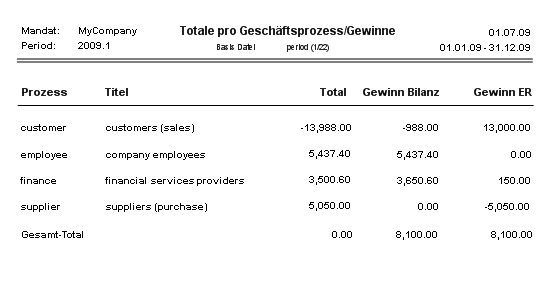
In a variant the process can be assigned to the contract. Instead of booking processes this leads to business processes. Contract partners like clients, suppliers, banks, hirers, employees etc. are assigned to a process. In this case the report will show the contribution of the single contract partners or contract partner groups to the total profit/loss (employees - without income statement related bookings - and suppliers paid with 10'487.40; revenues bank interest and customer sales + VAT 7.6% received with 14'138 leads to the current cash total of 3'650.60):
Development of the total profit as sum This report makes apparent again that the sum of the profits in the balance minus the sum of the profits in the income statement over all bookings of one or more batches will always result to zero (see the chapter above about Luca Pacioli). Diffences in the profit of the balance and the income statement are due to payments. With a payment the balance position of a contract partner is cleared, while his income-statement related expense or revenue remains still active. The business process must be analysed over an entire period and all included batches. With the booking process however the profit is calculated only for the batches assigned to the process. In this case, balance and income statement will always show the same profit total per process, since each booking process includes only batches with a total of zero. |
|